
Clarksburg City Directory Holdings
The West Virginia State Archives directory inventory provides the strongest official year list for Clarksburg. It begins with a combined 1900-01 holding, names scattered early and mid-century volumes, then shows a long later run. Gaps must remain visible. The list does not establish that every year was published, digitized, or available on demand.
| Collection | Years | Where Held | Access |
|---|---|---|---|
| Early Clarksburg volumes | 1900-01, 1917, 1923, 1939, 1946 | West Virginia State Archives | Confirm the exact volume and access with the archive |
| Polk metadata and editions | 1955, 1956, 1957, 1959 | Google Books metadata; archive holdings overlap in part | Catalog discovery; page access varies |
| Selected mid-century holdings | 1957-1959, 1964, 1966 | West Virginia State Archives | Year-specific snapshots |
| Long later archive run | 1971-2010 | West Virginia State Archives | Check each edition before planning a visit |
| Latest listed holdings | 2012-2016 | West Virginia State Archives | No later printed holding was verified |
The archive list does not name a complete reverse-directory series, and Waldomore's public pages do not publish reverse or criss-cross years. Ask staff whether those books sit under a telephone-directory or local-history title. Do not fill an absent year from an unsourced online index.
View the official Clarksburg year inventory captured from the State Archives.
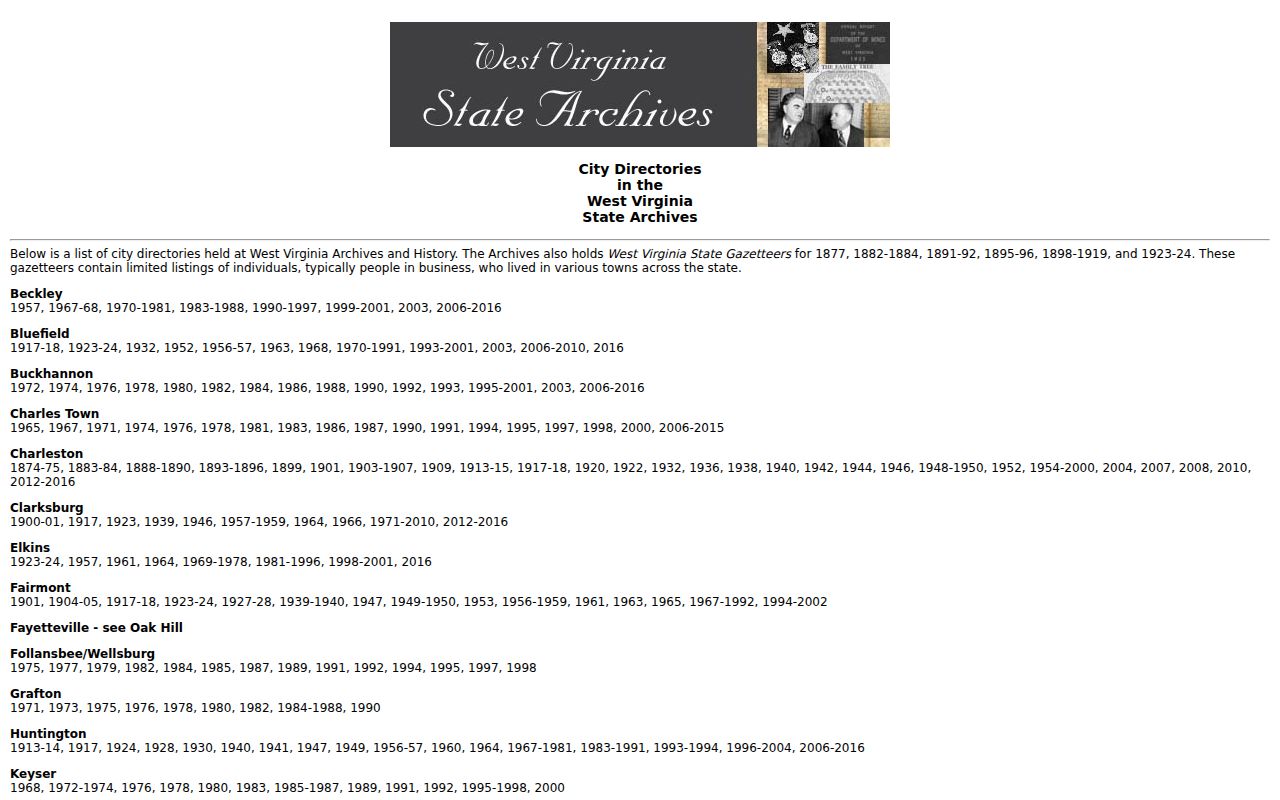
The captured list is a finding aid, so the exact edition and page still belong in every citation.
Clarksburg Directories at Waldomore
Waldomore is the local research-room route for Clarksburg and Harrison County genealogy. Built in 1842 by Waldo P. Goff and Harriet Moore, it served as the library home from 1931 through 1975. Its second-floor room is open by appointment Monday through Friday, 10:00 a.m. to 6:00 p.m. Ebony McGill is listed as manager at 304-627-2236 extension 220 and waldomore@clarksburglibrary.org.
See the library visit information for planning a Waldomore appointment.
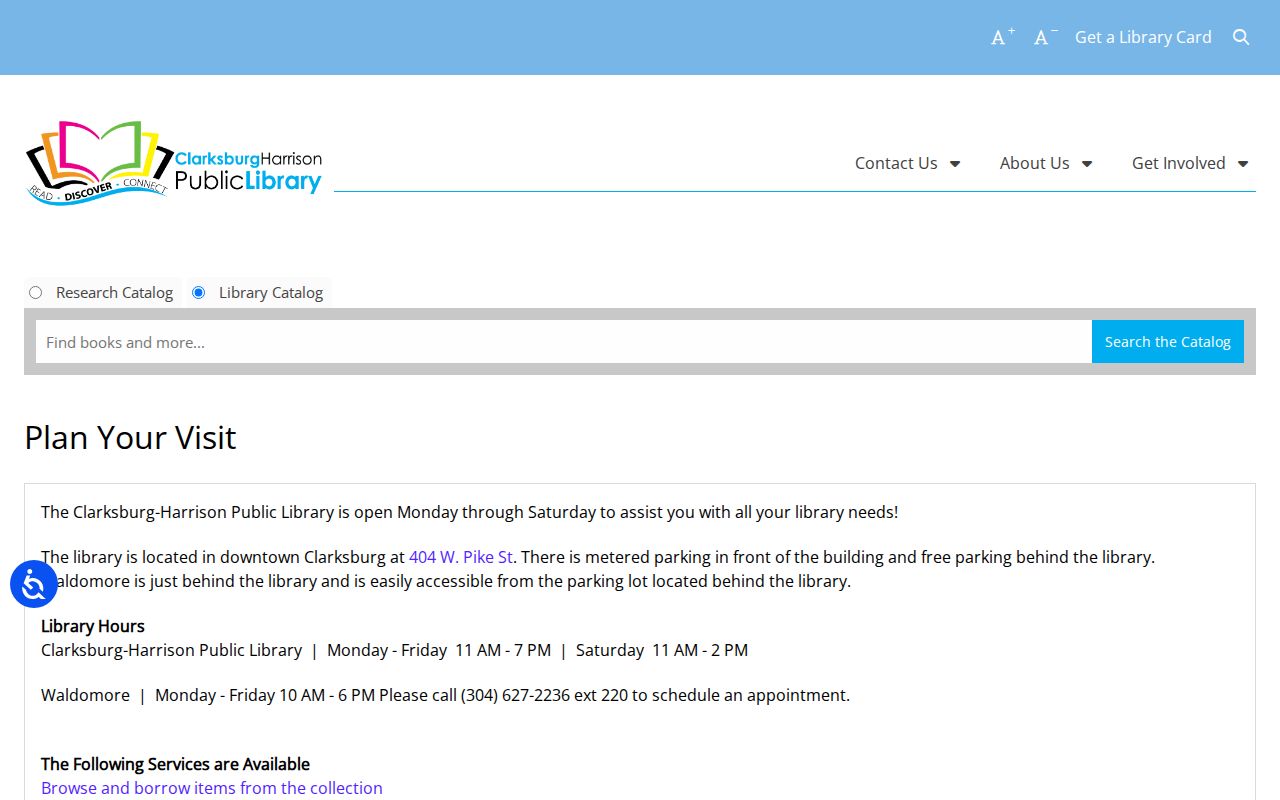
The visit page helps separate main-library hours from the appointment-based archive room.
Call numbers beginning WALDOMORE or ARCHIVES identify likely material. Ask for the exact title, edition, collection, box or call number, handling rule, and reproduction permission. Fragile originals require staff help. The main library at 404 W Pike Street also offers newspaper and obituary requests, copies, scanning, and local-history help.
Polk's Clarksburg Directory Trail
The Google Books record for Polk's Clarksburg identifies volume 29 from 1956, published by R.L. Polk & Co. and digitized from a University of Virginia copy. Metadata and search snippets also point to 1955, 1957, and 1959 editions. This is useful edition evidence, but the inspected view did not expose a reliable page-level sample entry.
Open the captured catalog page for the 1956 Polk volume.
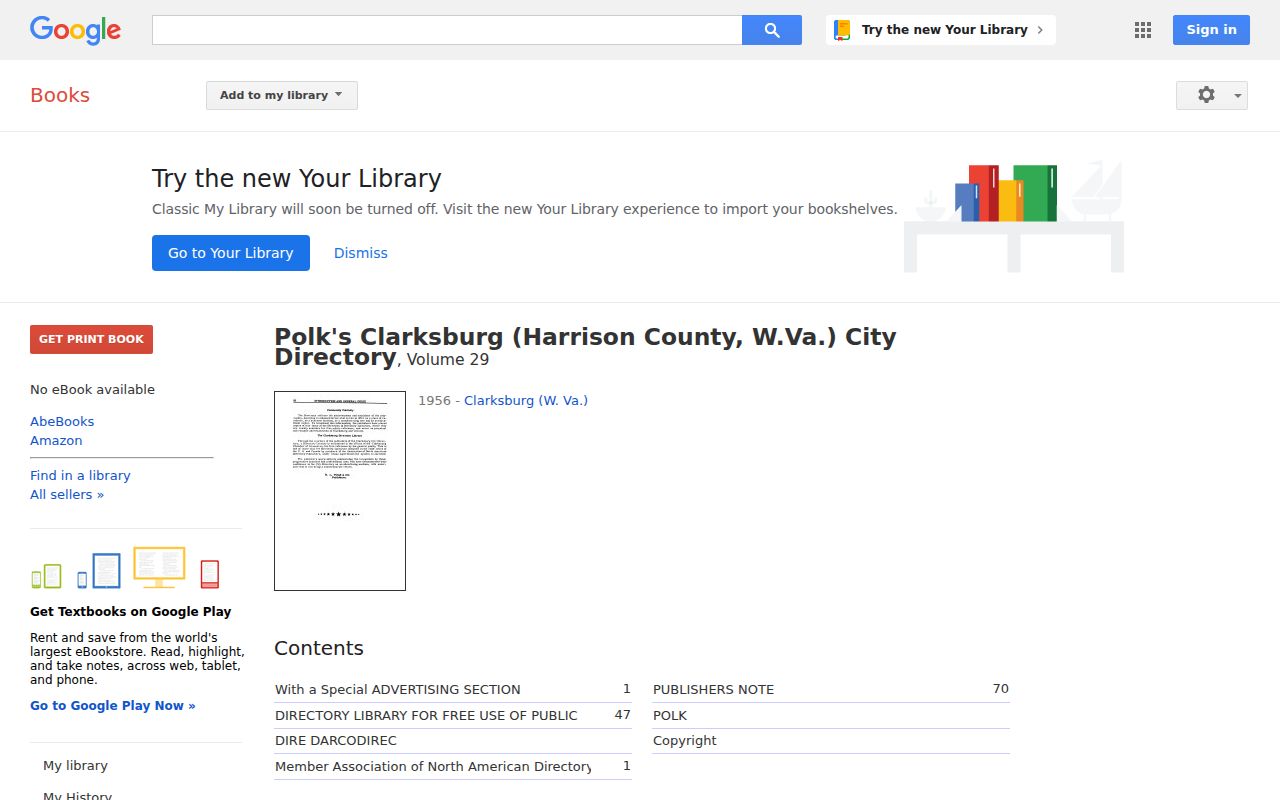
The image confirms edition metadata, not the text of any resident entry.
A historic-district study also cites a 1901 Polk directory, while the State Archives lists a combined 1900-01 holding. Those descriptions may refer to related material, but they should not be merged without checking the catalog or scan. This small mismatch is a good example of why city directory research records the source's own title.
Note: A catalog record proves that an edition exists; only the volume page can support a claim about a printed person or address.
Read a Clarksburg Directory Entry
Read an entry exactly as the volume prints it. A Clarksburg city directory may show a surname, given name, street and house number, household marker, occupation or business line, telephone number, or a cross-reference. Fields vary by edition. Never supply a spouse, owner mark, or expanded abbreviation unless that volume provides it.
| Name | Preserve the printed surname and given name, including odd spelling |
|---|---|
| Street and number | A dated location clue that must be reconciled with maps or deeds |
| Household marker | May show spouse, widow, boarder, or another role if the key defines it |
| Occupation or business | A historical association, not a current fact |
| Cross-reference | An alternate name or entry that should be followed and cited |
| Edition and page | The facts needed to reproduce the finding |
- Criss-cross directory
- A street-order listing used to search an address before a surname. Local titles and years still need confirmation.
- Householder index
- A list centered on the person shown as head of a listed household, not every occupant.
- Abbreviation key
- The edition's own guide to shortened roles, streets, and terms. Copy it before expanding any mark.
OCR can turn a surname or house number into a false lead. Compare the text transcription with the page image. Copy any “see” entry, record both pages, and retain the uncertainty when a character cannot be read.
Clarksburg Names Beyond Directories
Waldomore's holdings widen a city-directory clue without replacing the directory. The archive lists photographs, portraits, diaries, letters, posters, maps, high-school yearbooks, church histories, cemetery listings, obituaries, cookbooks, local authors, and artifacts. These sources may explain a name, school, church, organization, or street that appears in one edition.
The Gray Barker collection is a distinctive example of private papers preserving correspondence and community networks.
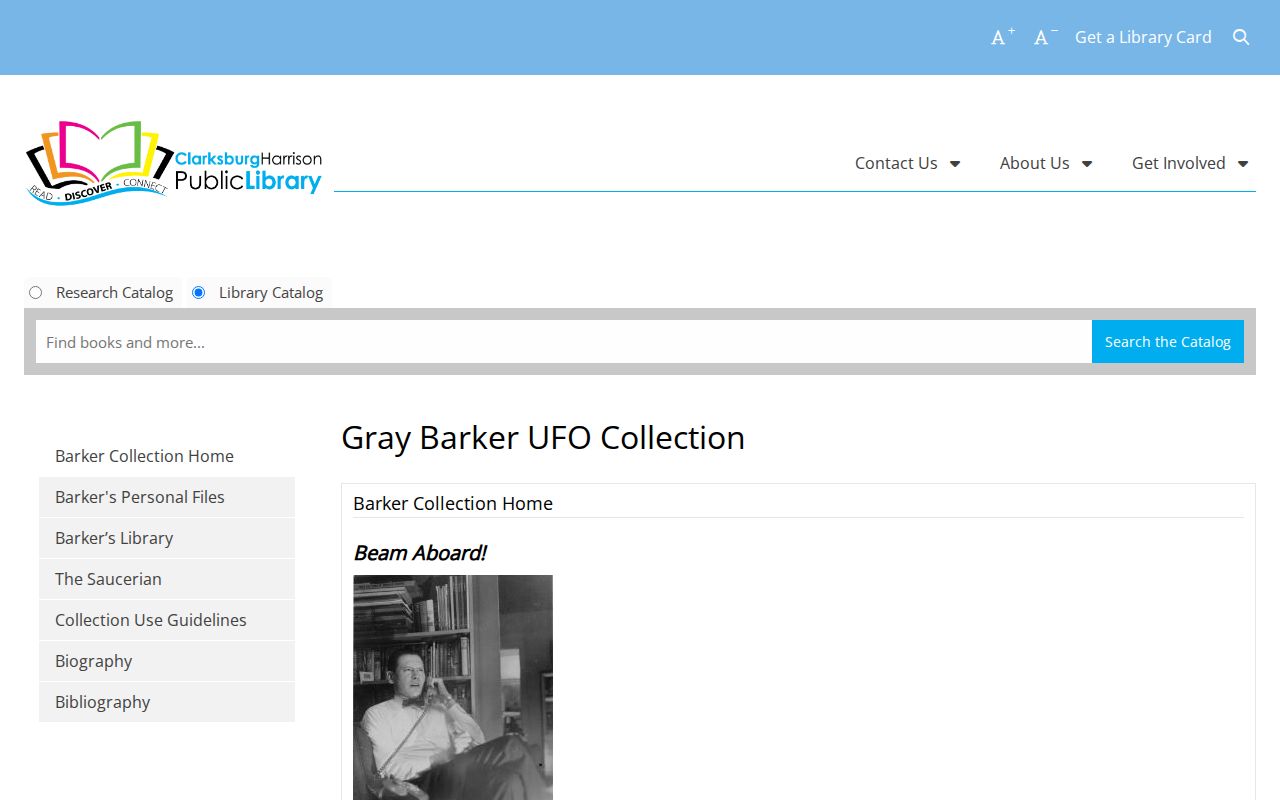
Names in the collection are archival leads; they are not a complete roll of Clarksburg residents.
The Harrison County Genealogical Society also supports some local genealogy material. Ask the research-room staff about access and scanning before a visit. A call number and box are more useful than a broad request for “anything” on a surname.
Map Clarksburg Directory Addresses
Library of Congress Sanborn maps can place a printed address in its built setting. Clarksburg sets survive for 1884, 1890, 1911, and 1916. The 1911 set has 37 sheets, and the 1916 set has 42. They show footprints and uses, not residents. Record the year, sheet, street label, and nearby landmark before drawing a link.
Later sheets preserve search terms such as Point Comfort, Adamston, Stealey Heights, Broad Oaks, Industrial, Grasselli, Norwood, North View, Golf Plaza, and New Fair Grounds. Those words may improve a directory or newspaper query. They should not be presented as exact current neighborhood boundaries.
Chronicling America lists the Clarksburg Telegram from 1874 to 1926, the Daily Telegram from 1901 to 1926, and Cooper's Clarksburg Register from 1851 to 1861. Digitized issue coverage is partial. Search the surname with the street, church, school, or business, then verify OCR against the issue image.
Note: A map shows a structure, and a newspaper reports an event; neither proves a whole household occupied an address.
Clarksburg Directory Research Timeline
Clarksburg records sit in a longer county and city history. Harrison County was founded in 1784, while the directory shelf begins much later. The official court-history source traces five courthouses, and present records offices are concentrated downtown. Repository labels can change even when an older record survives.
| Year | Research marker |
|---|---|
| 1784 | Harrison County established; early county books and marriage-bond series begin the wider record trail |
| 1884 | Earliest listed Clarksburg Sanborn sheet |
| 1900-01 | Earliest explicit State Archives city directory holding |
| 1917 | Directory holding and charter revision provide a useful paired time point |
| 1956 | R.L. Polk volume 29 identified in catalog metadata |
| 2016 | Latest Clarksburg directory year on the inspected archive list |
The sequence is not a claim of continuous publication. It simply marks sources that can be joined by a name, address, map, or dated event.
Clarksburg's New Story Archive
A 2026 report describes a Clarksburg History Museum effort to expand digital preservation through a Story Archive. Residents can bring photographs, letters, maps, and artifacts for scanning and record oral histories with the Harrison County Historical Society room. This community project can preserve details absent from a printed city directory.
Read the report about the Clarksburg Story Archive initiative.

The project supplies family and neighborhood leads, but an oral account should be paired with a dated directory, map, newspaper, or deed.
Preserve who supplied the story and when. Scan captions and the backs of photographs when allowed. A remembered street name may point to a Sanborn sheet or edition, even when today's map uses a different label.
Trace Clarksburg Families by Year
A directory sequence is strongest when paired with federal census releases through 1950, newspapers, deeds, obituaries, and vital indexes. Begin near a known date and move one listed volume at a time. Record absences rather than explaining them too soon. A person may have moved, died, changed a surname, lived under another householder's listing, or simply been omitted.
- Choose the nearest verified edition and copy the name, address, marks, page, and repository.
- Check the prior and next available years. Note every move, spelling change, business line, and cross-reference.
- If a street-order section exists, compare the house number and nearby listings. Confirm its title and year first.
- Pair directory dates with census years. Cite the census year, enumeration district, and sheet rather than relying on a name-only match.
- Test the last appearance through a newspaper, obituary request, cemetery listing, deed, or eligible vital-record route.
The next step depends on the question. For the modern parcel and deed trail, the Clarksburg street directory explains address-keyed records without repeating the historical shelf. For archive work, keep all old address forms, since Clarksburg's growth and uneven street connections can break a name-only search.
Citation rule. Keep the directory title, edition year, printed page, repository, collection or call number, and image or access date together.